7 Reasons Selling Your Home This Fall Could Make Sense
You could sell your home for more next spring and still end up with a more expensive move.
How?
The home you want could cost more, too. Mortgage rates could change. And waiting means continuing to pay for a home you may already
be ready to leave.
That doesn't automatically make fall the right time to sell.
But if you're planning to sell AND buy, there's a better question than "Can I get more for my home in spring?"
Will waiting actually put me in a better position overall?
Here are seven things worth considering.
1. Your Equity May Give You More Options Than You Realize
Twin Cities home prices are still rising, albeit modestly.
The September median sale price reached $395,000, up 1.3% from last year, according to Minnesota Realtors.
If you've owned your home for several years, appreciation and mortgage payments may have built substantial equity.
That could mean a larger down payment, less debt, or more flexibility in choosing your next home.
What matters isn't just your home's value. It's what you'd actually walk away with after selling.
2. Buyers Have More Homes to Choose From
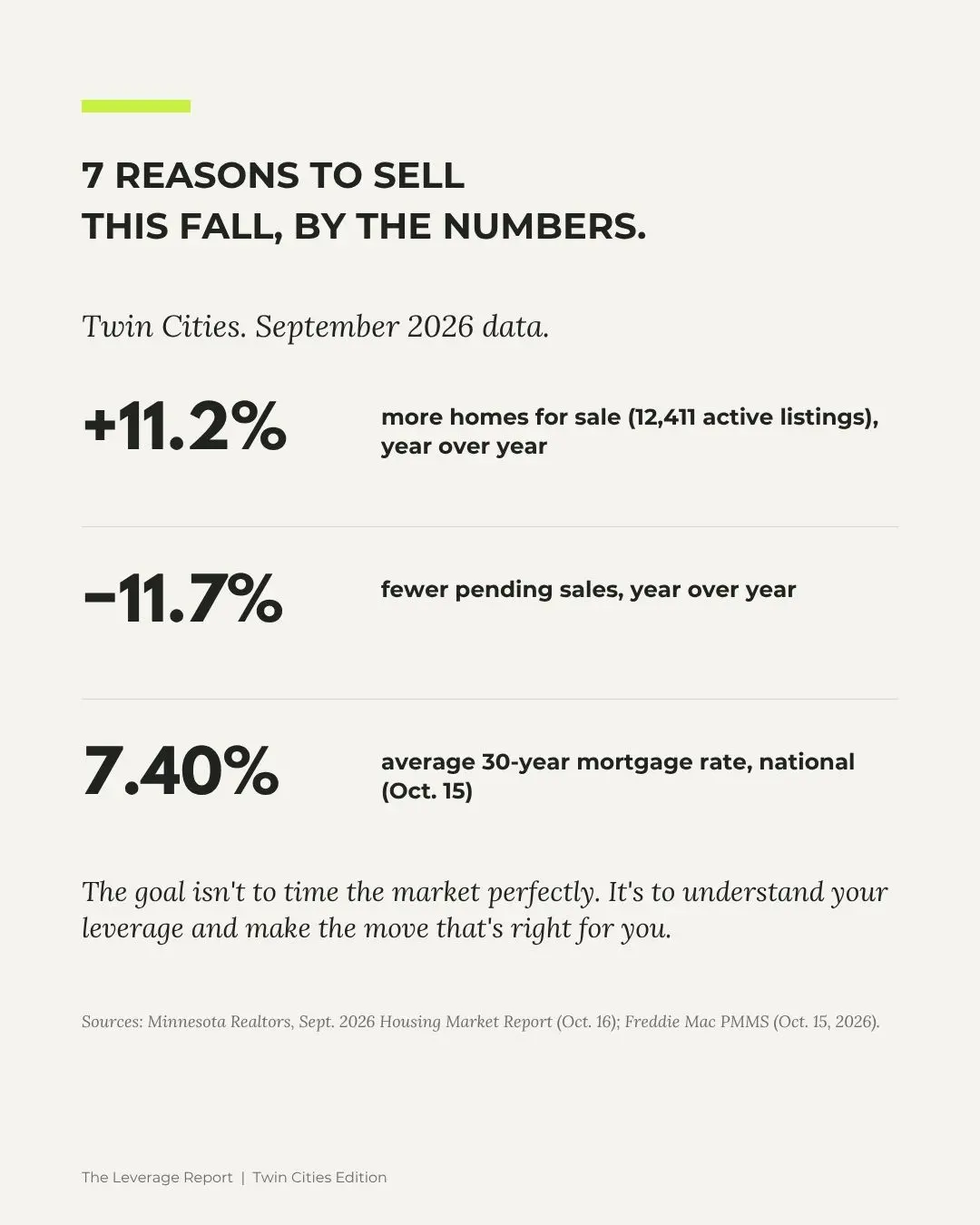
Twin Cities inventory increased 11.2% year over year, reaching 12,411 homes in September.
More inventory generally means more choices and potentially less pressure to make rushed decisions.
That's particularly valuable if you're selling one home to buy another.
Not every neighborhood or price range offers the same opportunities, but buyers have more options than they did a year ago.
3. Less Buyer Competition Can Work Both Ways
Pending sales declined 11.7% in September compared with last year.
For sellers, fewer buyers can mean longer marketing times and more pressure to price competitively.
But if you're buying your next home, you may face less competition, too.
You might give up some negotiating leverage when selling while gaining some when buying.
The question is how those two transactions work together.
4. A Higher Sale Price Doesn't Guarantee a Better Move
Imagine selling a $450,000 home and buying a $550,000 home.
Now suppose both appreciate 3% before spring.
Today | After 3% increase | |
Your home | $450,000 | $463,500 |
Next home | $550,000 | $566,500 |
Price difference | $100,000 | $103,000 |
You'd sell for $13,500 more, but your next home would cost $16,500 more.
Your price gap actually increases by $3,000.
That's a hypothetical illustration, not a forecast. Actual prices, financing, and selling costs will vary.
Selling for more isn't necessarily the same as coming out ahead.
5. Mortgage Rates Matter, but They're Not the Whole Equation
Freddie Mac reported a 7.40% average 30-year mortgage rate on October 15.
If you're holding a 3% mortgage, giving it up is a serious consideration. For some homeowners, staying put makes financial sense.
But waiting for lower rates isn't a guaranteed strategy.
Rates could fall, remain elevated, or rise. And lower rates could bring more buyers back into the market.
Instead of predicting rates, compare what you can actually control: your equity, next purchase price, borrowing needs, and monthly costs.
The rate matters. So does the amount you need to borrow.
6. A Slower Market Can Create Negotiating Opportunities
Twin Cities homes spent an average of 48 cumulative days on market in September, compared with 44 last year.
Sellers received an average of 97.7% of their original asking price.
That suggests some buyers may have more room to negotiate.
And negotiations aren't limited to price.
Closing-cost assistance, repairs, closing dates, and other terms can make a meaningful difference.
If you're selling and buying, the best outcome may come from the combined terms of both transactions.
7. Your Life Doesn't Follow the Housing Market's Calendar
Maybe you need more space.
Maybe you're ready to downsize, reduce maintenance, or move closer to family.
Those reasons matter, even if they don't appear on a spreadsheet.
Waiting another six months might improve your financial position. It might not.
But it also means another six months in a home that may no longer fit your needs.
That doesn't mean you should rush into an expensive move.
It means the financial decision and the personal decision deserve to be evaluated together.
So, Should You Sell This Fall or Wait Until Spring?
The Twin Cities market is giving buyers more choices while requiring sellers to be more strategic.
For homeowners planning to sell and buy, that creates both challenges and opportunities.
Before deciding to wait, I'd start with three numbers:
1. What could your home realistically sell for today?
Based on its condition, location, comparable sales, and current competition.
2. What would you actually walk away with?
Your estimated proceeds after mortgage payoff and selling expenses.
3. What would your next move really cost?
Including the purchase price, financing, taxes, insurance, and monthly payment.
With those numbers, you can compare moving now with waiting until spring.
You may discover that waiting is the smarter decision.
Or you may find that moving sooner puts you in a stronger position than you expected.
The goal isn't to time the market perfectly. It's to understand your leverage and make the move that's right for you.
The Leverage Report | Twin Cities Edition
Grant Farnum, REALTOR® | Pederson Realty
Understand the market. Know your leverage.
Sources:
· Minnesota Realtors: September 2026 Housing Market Report, October 16, 2026.
· Freddie Mac: Mortgage Rates Hold Steady at 7.40%, October 15, 2026.