How Can You Attract Homebuyers Without Lowering Your Asking Price?
How Can You Attract Homebuyers Without Lowering Your Asking Price?
More sellers are competing for buyers. But what if the biggest obstacle isn't your asking price—it's what buyers can afford each month?
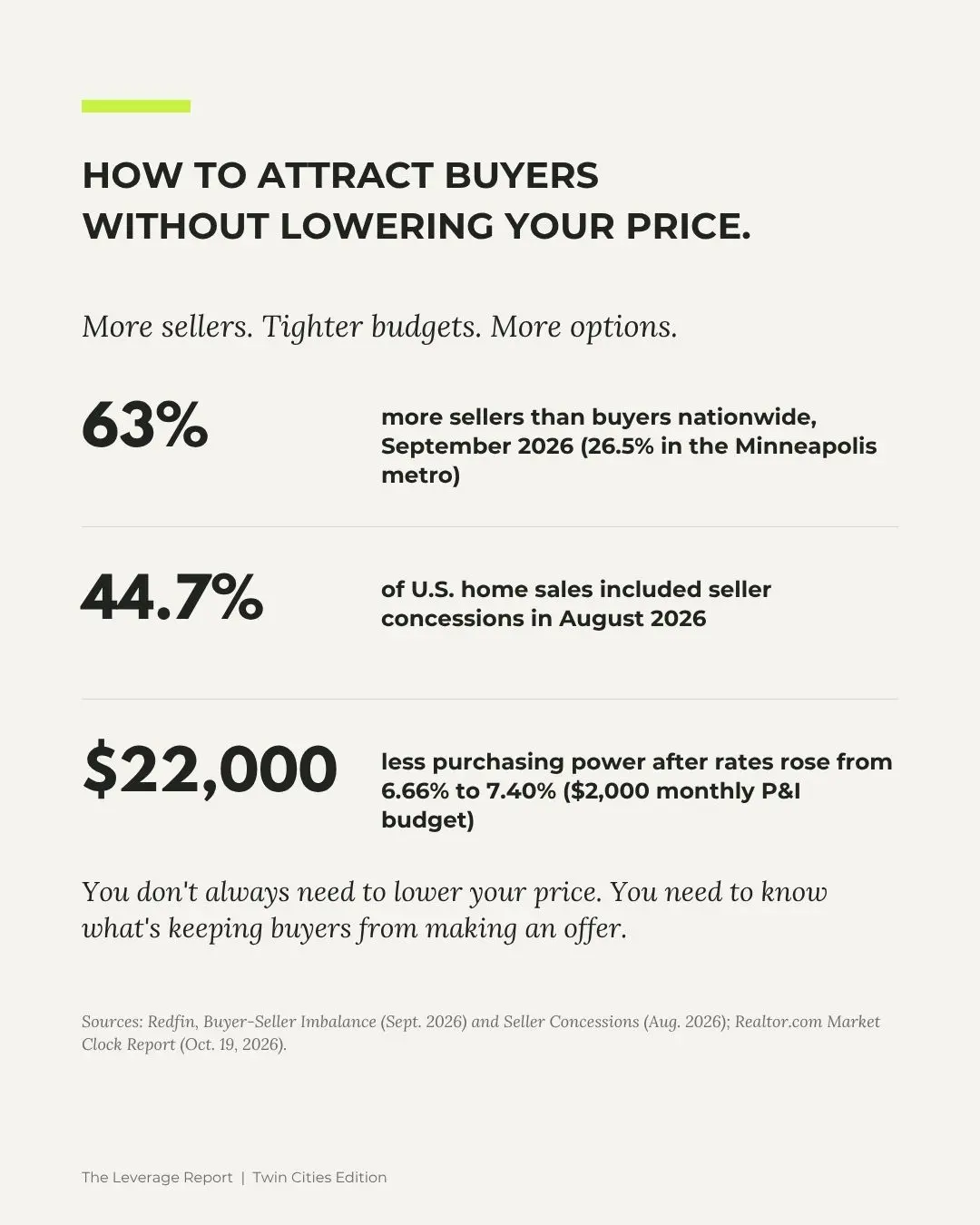
According to Redfin, there were approximately 63% more home sellers than buyers nationwide in September 2026. In the Minneapolis metro, the estimated gap was smaller: 26.5% more sellers than buyers.
That means more competition for sellers. But a price reduction isn't necessarily the only solution.
Sellers can attract homebuyers without lowering their asking price by offering closing-cost credits, mortgage-rate buydowns, repairs, or flexible closing terms. The best strategy depends on what buyers need and how each option affects the seller's net proceeds.
Here's what that could look like.
Why aren't more buyers making offers?
A recent Realtor.com report highlighted an interesting contradiction.
Buyers have gained negotiating power as more homes become available, but higher mortgage rates have reduced what they can afford.
Realtor.com estimated that an increase in mortgage rates from 6.66% to 7.40% reduced purchasing power by approximately $22,000 for a buyer with a $2,000 monthly principal-and-interest budget.
Think about that.
A buyer might love your home and agree that it's fairly priced, but still struggle with the monthly payment.
And a modest price reduction might not solve that problem.
What are seller concessions?
Seller concessions are incentives that help buyers with certain expenses associated with purchasing a home.
They might include closing-cost assistance, mortgage-rate buydowns, or negotiated repair credits.
They're becoming more common, too.
According to Redfin, 44.7% of U.S. home sales included seller concessions during the three months ending August 2026.
And sellers aren't the only ones using incentives.
The National Association of Home Builders reported that 65% of builders offered sales incentives in October, while 43% reduced prices.
The takeaway?
Buyers aren't just comparing home prices. They're comparing what it takes to actually purchase and afford each home.
5 ways to attract buyers without cutting your price
1. Help lower the buyer's mortgage payment
A seller-paid mortgage-rate buydown can reduce a buyer's monthly payment.
Depending on the loan and how the buydown is structured, the savings may be temporary or permanent.
For a buyer concerned about monthly affordability, that could be more attractive than a modest price reduction.
2. Help cover closing costs
Even buyers who can afford a monthly payment may struggle with upfront expenses.
Closing costs can include lender fees, title expenses, prepaid taxes, and insurance.
A seller credit toward eligible expenses can help buyers preserve cash for moving, emergencies, or home improvements.
Sometimes reducing the cash needed upfront matters more than reducing the purchase price.
3. Address expensive repairs
An aging furnace, questionable roof, or deferred maintenance can create uncertainty.
Completing repairs before listing—or negotiating an appropriate credit—may remove an obstacle to an offer.
Buyers aren't just evaluating what a home costs today. They're thinking about what it might cost them tomorrow.
4. Offer flexible closing terms
Sometimes the biggest challenge isn't money. It's timing.
A flexible closing date, possession arrangement, or other negotiated terms could make your home more appealing without changing its price.
Convenience can have real value.
5. Compare a seller credit against a price reduction
Imagine you're selling a home listed at $400,000.
You could reduce the asking price to $390,000.
Or you could consider keeping the price at $400,000 and offering a $10,000 credit toward eligible buyer expenses.
Which is better?
It depends on what the buyer needs—and what you actually net from the sale.
A price reduction lowers the purchase price and generally reduces the mortgage payment.
A seller credit might help cover upfront expenses or fund a mortgage-rate buydown.
Neither approach is automatically better.
Seller concessions are subject to financing limits, and the home must still support the agreed-upon price through the appraisal process.
The goal is to compare the actual numbers, not just the advertised price.
What if you're selling one home and buying another?
Here's where things get especially interesting.
You might face more competition when selling your current home while enjoying more negotiating power when buying the next one.
Imagine offering a concession to help sell your home, then negotiating a similar benefit when purchasing your next one.
Those concessions won't necessarily offset each other dollar for dollar.
But the bigger question becomes:
What will your entire move actually cost?
That includes your sale proceeds, next purchase price, financing, monthly payment, and timing.
A slightly lower sale price could still make sense if you're gaining meaningful advantages on the purchase side.
The only way to know is to compare the numbers together.
Should you lower your asking price or offer a concession?
Before making that decision, consider three questions:
1. Is your home priced competitively?
Concessions aren't a substitute for accurate pricing. If comparable homes offer better value, a price adjustment may be necessary.
2. What's actually keeping buyers from making offers?
Is it the monthly payment, upfront cash, repairs, timing, or the home's price relative to competing properties?
3. Which strategy produces the best overall financial outcome?
Compare your likely net proceeds, the buyer's financing needs, and your goals for the next move.
Sometimes a concession makes sense. Sometimes better preparation or marketing is enough. And sometimes lowering the asking price really is the smartest decision.
The bottom line
You don't always need to lower your asking price to attract buyers. You need to understand what's keeping them from making an offer.
The right strategy starts with competitive pricing, understanding buyer concerns, and comparing your options.
Especially if you're planning to sell and buy another home.
Because a successful sale isn't just about getting the highest price.
It's about making your next move work for you.
The Leverage Report | Understand the market. Know your leverage.
Sources:
· Redfin — September 2026 Buyer-Seller Imbalance Report
· Redfin — August 2026 Seller Concessions Report
· Realtor.com — October 19, 2026 Mortgage Rate and Purchasing Power Report
· National Association of Home Builders — October 2026 Builder Confidence Report