Why Are Some Twin Cities Homes Sitting Longer?
If you're thinking about selling your home in the Twin Cities, there's a number worth paying attention to right now.
But it isn't the mortgage rate.
And it isn't the median sale price.
It's how many other choices your buyer has.
Twin Cities buyers have more homes to choose from than they did a year ago. At the same time, recent showing activity has slowed considerably.
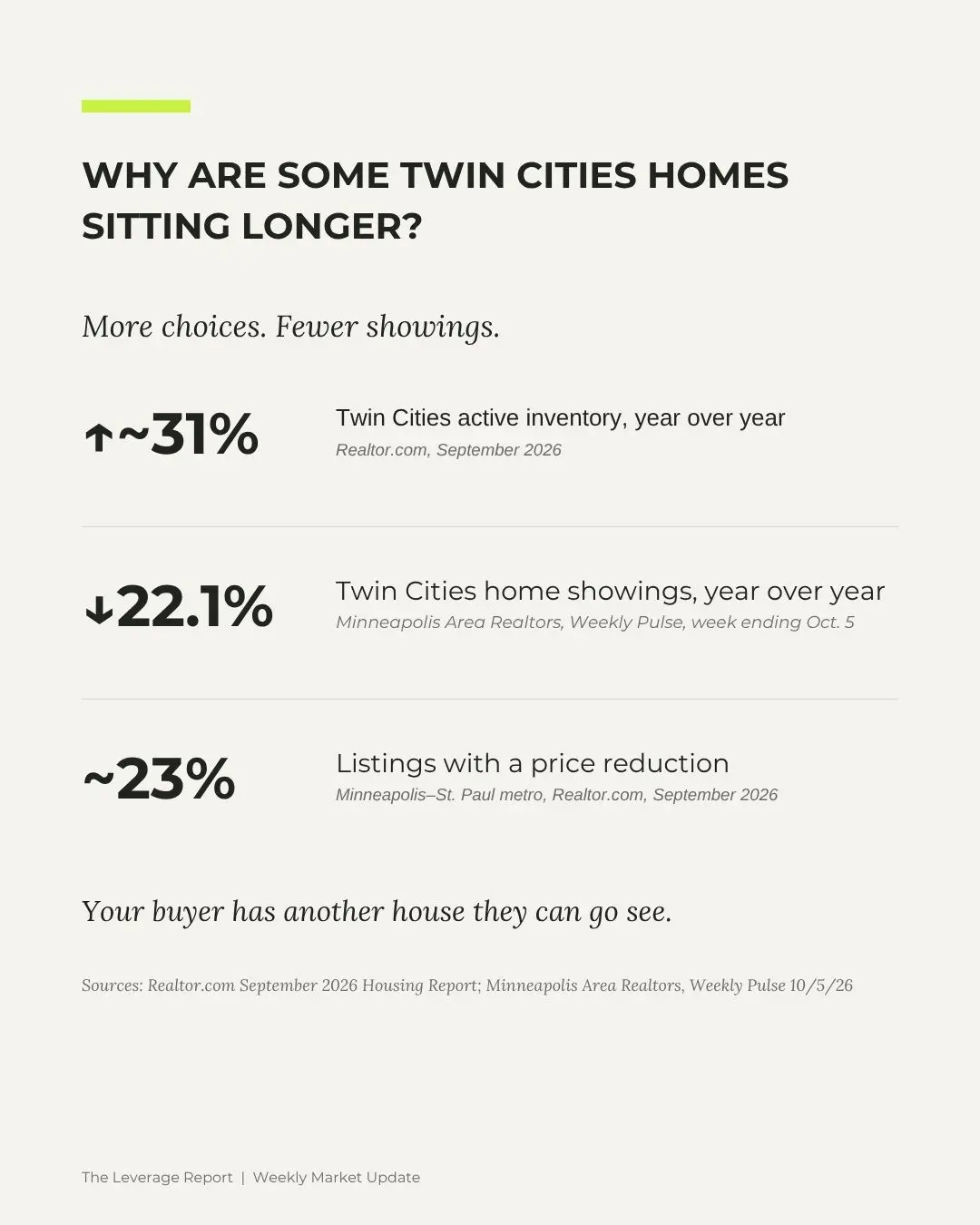
According to the latest Minneapolis Area Realtors data, Twin Cities home showings were down 22.1% from the same week last year.
Put those two things together:
More choices. Fewer showings.
That doesn't mean homes aren't selling.
It doesn't mean Twin Cities home values are collapsing.
And it definitely doesn't mean every seller needs to cut their price.
But it does change the environment you're selling into.
Because your house isn't only competing with the new listing that hit the market this morning.
It's competing with everything buyers haven't bought yet.
Why are some Twin Cities homes taking longer to sell?
One important reason is that inventory is accumulating.
September data from Realtor.com showed active inventory in the Minneapolis-St. Paul metro up roughly 31% from a year earlier.
But here's the interesting part:
New listings were actually slightly lower than last year.
Think about what that means.
The increase in available homes isn't simply coming from a flood of homeowners suddenly deciding to sell.
Homes are also staying available longer.
When fewer listings leave the market quickly, inventory builds.
And every unsold home becomes another option for the next buyer.
What does more inventory actually mean for a home seller?
More inventory doesn't automatically mean your home is worth less.
It means your buyer has alternatives.
Imagine a buyer looking for a four-bedroom house around $500,000.
If there are two realistic options, both sellers may have significant leverage.
If there are twelve?
The buyer can compare:
Price.
Condition.
Updates.
Location.
Taxes.
Layout.
Monthly payment.
Days on market.
Seller concessions.
And how each house feels when they walk through it.
Suddenly, your house doesn't need to be “bad” for the buyer to move on.
Another house simply needs to make more sense.
That's the shift sellers need to understand.
Are Twin Cities home prices falling?
This is where housing headlines can become misleading.
More inventory does not automatically mean falling home values.
The latest available Twin Cities sale-price data still showed prices higher than a year ago.
So two things can happen simultaneously:
Your home's market value can remain strong.
And:
Your negotiating leverage can weaken because buyers have more alternatives.
Those aren't contradictory.
Price tells us what homes are selling for.
Inventory and buyer activity tell us something about the environment those homes are selling in.
For a seller, you need to understand both.
Why are so many sellers reducing their price?
September data showed roughly 23% of Minneapolis-St. Paul listings had experienced a price reduction.
That's useful information.
But a price reduction doesn't necessarily mean:
“This house lost value.”
Sometimes it means:
“The original price didn't match the market that actually showed up.”
There's a big difference.
A list price is ultimately an asking price.
The market responds to it.
If buyers see the house, compare it with their alternatives and consistently choose something else, that's information.
The dangerous move is ignoring that information because the seller believes:
“Someone will eventually pay what I want.”
Maybe.
But while you're waiting, new competition can appear, existing competition can reduce its price, and buyers can begin wondering why your home hasn't sold.
Why does the first week on the market matter?
A new listing has something an older listing doesn't:
Novelty.
When your home first hits the market, every buyer already searching in that price range sees something new.
Agents notice it.
Saved searches trigger.
Buyers who haven't found the right house yet may immediately take a look.
That's valuable attention.
If the home is positioned poorly during that window, you don't necessarily get the same opportunity again by lowering the price three weeks later.
You can absolutely reposition a listing.
But it's usually easier to capitalize on buyer attention the first time you have it.
That's why I'd rather spend more time getting the strategy right before the home hits the market than spend the next month trying to correct it afterward.
Does this mean sellers should price low?
No.
The lesson isn't:
“Price your house cheap so it sells.”
The goal is to understand where your house fits among the alternatives buyers actually have.
That requires looking at more than recently sold homes.
Sold comparable properties help us understand value.
But if you're selling today, I'd also want to study:
What's active right now?
What homes will buyers see before or after yours?
How do those homes compare?
Which listings have reduced their price?
Which homes are sitting?
Which ones sold immediately?
What condition were they in?
What did buyers apparently reward?
And what did they ignore?
Because the house that sold four months ago helps us understand value.
The house listed down the street today may be your actual competition.
What should Twin Cities sellers do differently right now?
I'd focus on four things.
1. Understand your actual competition
Don't just ask:
“What did my neighbor's house sell for?”
Ask:
“What else can my buyer purchase today?”
Those are different questions.
2. Prepare before you list
When buyers have alternatives, small objections become easier reasons to move on.
That doesn't mean remodeling the kitchen before selling.
It means identifying the things most likely to affect how buyers perceive the home and deciding deliberately what is worth addressing.
Sometimes the answer is a repair.
Sometimes it's paint.
Sometimes it's cleaning and staging.
Sometimes the smartest decision is to do nothing at all.
3. Treat your list price as a strategy
The highest possible list price isn't necessarily the strategy that produces the highest sale price.
Your initial price affects who sees the home, what alternatives they compare it with and how urgently they feel they need to act.
Price is part of the marketing.
4. Listen to the market quickly
No showings?
Lots of showings but no offers?
Repeated feedback about the same issue?
Buyers choosing competing homes?
Those are different signals.
And they may require different responses.
The goal isn't to react emotionally to every showing.
It's to recognize a pattern before weeks of market time accumulate.
Should you wait to sell until the market gets better?
Not necessarily.
There's no universal answer because the reason you're moving matters more than a single housing statistic.
A seller who needs more space because their family has changed is making a different decision than someone casually considering downsizing five years from now.
The question isn't simply:
“Is this the perfect market to sell?”
I'd rather ask:
“What would selling allow you to do, and what would it cost you to make that move right now?”
Then we can decide whether the tradeoff makes sense.
Sometimes the answer will be yes.
Sometimes it'll be not yet.
Clarity is still a win.
The bottom line
Twin Cities sellers have more competition than they did a year ago.
Not necessarily because dramatically more homeowners suddenly decided to sell.
But because more homes are accumulating on the market while buyers have become more selective.
That doesn't mean your home won't sell.
It doesn't automatically mean your home's value has fallen.
It means buyers have more alternatives.
And when buyers have alternatives:
Preparation matters more.
Positioning matters more.
Pricing matters more.
Not because the sky is falling.
Because your buyer has another house they can go see.
Twin Cities Home Seller FAQ
Why are Twin Cities homes taking longer to sell in 2026?
Twin Cities buyers currently have more homes to choose from, while recent showing activity has declined from last year's levels. When homes leave the market more slowly, active inventory accumulates and buyers have more alternatives.
Is Twin Cities housing inventory increasing?
Yes. September 2026 data showed active inventory in the Minneapolis-St. Paul metro substantially higher than a year earlier, even though new listings were slightly lower year over year.
Does more housing inventory mean my Twin Cities home is losing value?
Not necessarily. More inventory means buyers have more choices, but the latest available Twin Cities sale-price data still showed prices above year-ago levels. Home value and seller negotiating leverage are related, but they are not the same thing.
Should I lower my home's price if it isn't selling?
Not automatically. First determine why the home isn't selling. Limited showings, strong showing activity without offers, repeated condition feedback and buyers choosing competing properties can signal different problems. Pricing is one possible adjustment, but it isn't the only one.
What should I look at before pricing my Twin Cities home?
Recent comparable sales matter, but sellers should also study their current competition: active listings, pending homes, recent price reductions, days on market, condition and what similar buyers can purchase right now.
Is fall 2026 a bad time to sell a home in the Twin Cities?
Not necessarily. Market conditions vary by neighborhood, price range, property type and the seller's goals. The better question is whether selling now helps accomplish what the homeowner is trying to do and whether the expected financial tradeoffs make sense.
Sources: Minneapolis Area Realtors, The Weekly Pulse, October 5, 2026. Realtor.com, September 2026 Housing Market Trends Report and Minneapolis-St. Paul metro market data. Minnesota Realtors and NorthstarMLS market data.