Your Low Mortgage Rate Is Saving You Money. But What Is It Costing You?
Should you give up a 3% mortgage to buy another home? Here's how Twin Cities homeowners can decide whether moving is worth it.
The Leverage Report | November 17, 2026 | 4–5 minute read
If you bought or refinanced your home when mortgage rates were around 3%, you have something millions of homeowners would love to have today.
A mortgage payment that's substantially lower than what a similar loan would cost now.
But what happens when the home attached to that great mortgage no longer fits your life?
Maybe your family needs more space. You're tired of maintaining a large property. Or you'd love to live closer to work, family, or the things you enjoy.
Yet every time you think about moving, the same thought stops you:
"I can't give up my mortgage rate."
That's understandable. But here's a question worth considering:
Are you staying because your home still works for you, or because your mortgage rate is too good to leave?
Those aren't necessarily the same thing.
Why are homeowners reluctant to give up their low mortgage rates?
It's called the mortgage rate lock-in effect.
Homeowners hesitate to sell because replacing their existing mortgage would mean borrowing at a substantially higher interest rate.
And the difference can be significant.
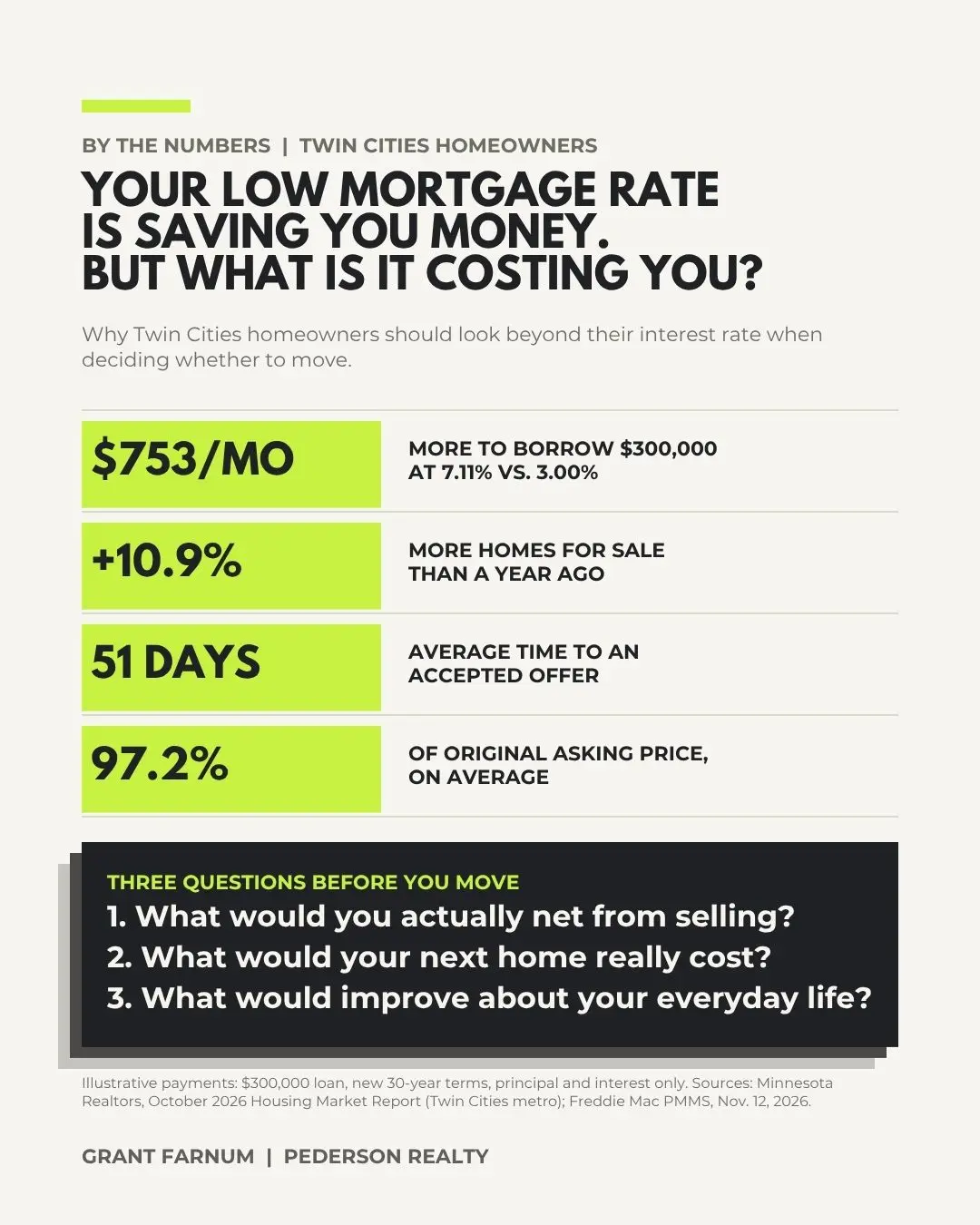
According to Freddie Mac, the average 30-year fixed mortgage rate was 7.11% on November 12, 2026.
Consider a $300,000 mortgage with a new 30-year repayment schedule:
Interest rate | Monthly principal and interest |
3.00% | $1,265 |
7.11% | $2,018 |
Difference | $753/month |
That's approximately $9,000 more per year, before taxes and insurance.
Illustrative payments based on equal loan amounts and new 30-year terms. Your actual payment depends on your loan balance, remaining term, and financing.
That's a compelling reason to stay.
But a great mortgage doesn't automatically mean you're in the right home.
What is staying in your current home actually costing you?
We tend to measure housing costs in dollars.
But what about the hour you spend commuting every day?
The basement that's become too small for your growing family?
Or the weekends spent maintaining a property you no longer need?
Those have costs, too. Some financial, others measured in time, energy, and quality of life.
And while those costs don't appear on your mortgage statement, they're still worth considering.
The question isn't whether moving would cost more.
It's whether the benefits of moving would justify the additional cost.
Could today's Twin Cities housing market create an opportunity?
Here's something interesting.
Higher mortgage rates have made buying more expensive, but they've also contributed to slower buyer activity.
According to Minnesota Realtors' October 2026 housing report:
· 12,137 homes were available for sale, up 10.9% year over year.
· Homes took 51 cumulative days to reach an accepted offer, up 6.3%.
· Sellers received an average of 97.2% of their original asking price.
· The median sale price was $400,000, up 2.6% from last year.
Buyers generally have more choices, and some sellers may be more willing to negotiate price, repairs, closing costs, or financing incentives.
But there's a catch.
If you're selling one home to buy another, you're participating in the market twice.
You may face more competition when selling, but you could also have more negotiating opportunities when purchasing.
The important question is how both transactions work together.
Three questions to ask before giving up your low mortgage rate
1. What would I actually walk away with if I sold?
Suppose your home could sell for $450,000 and you owe $200,000.
That's $250,000 in gross equity, before selling expenses and other costs.
Your actual net proceeds could provide a substantial down payment on your next home, reducing the amount you'd need to borrow.
A higher interest rate on a smaller mortgage may be more manageable than you expect.
That's why comparing interest rates alone doesn't tell the whole story.
2. What would my next home really cost?
Compare the complete monthly expenses of both homes:
· Mortgage principal and interest
· Property taxes and insurance
· HOA dues, if applicable
· Utilities and maintenance
Then consider the purchase price, down payment, moving expenses, and cash reserves you'd have afterward.
You might also explore seller-paid closing costs or a mortgage-rate buydown.
These options have costs and financing restrictions, but they can sometimes help make a purchase more manageable.
The goal isn't to justify a higher payment. It's to understand whether you can comfortably afford the move.
3. What would improve about my life if I moved?
Would moving shorten your commute?
Give your family more room?
Reduce maintenance responsibilities?
Put you closer to people and activities that matter most?
Those benefits don't automatically justify spending more.
But they're legitimate parts of the decision.
Your home isn't just a financial asset. It's where your life happens.
Should you wait for mortgage rates to fall?
Maybe. But don't base your entire decision on a prediction.
If mortgage rates decline, your future payment could become more affordable.
However, lower rates could also bring more buyers into the market, increasing competition.
And nobody can reliably predict when rates will fall or how far.
Here's a better approach:
Make your decision using today's numbers. Treat future rate changes as possibilities, not promises.
If moving only works financially when rates drop significantly, waiting may be the responsible choice.
If the move works comfortably today, a future refinance might offer additional savings, but it shouldn't be necessary for the purchase to make sense.
And if staying is the better decision, you can still make a plan.
Consider improvements to your current home, establish a target budget for your next move, and revisit the numbers as circumstances change.
The bottom line: Is giving up a low mortgage rate worth it?
It can be, but only when the financial and personal benefits of moving justify the additional costs.
For some homeowners, keeping a 3% mortgage is absolutely the right decision.
For others, staying in a home that no longer fits may come with trade-offs they haven't fully considered.
Before deciding, understand three things:
1. What you'd actually net from selling.
2. What your next home would cost.
3. What staying or moving would mean for your everyday life.
A low mortgage rate is a valuable financial advantage.
But it shouldn't make every housing decision for you.
If you're considering a move, my companion guide, 17 Questions to Ask Before You Sell Your House, explores the other decisions worth understanding, from pricing and timing to repairs, equity, and finding your next home.
You don't have to be ready to sell to start planning.
Sometimes the most valuable outcome is discovering that staying where you are is the right decision.
Here's a question worth asking yourself:
If your mortgage rate weren't part of the equation, would you still choose to live in your current home?
Your answer might tell you where to start.
Frequently Asked Questions
Is it a bad idea to give up a 3% mortgage?
Not necessarily. It depends on your equity, new mortgage balance, total housing expenses, and reasons for moving. Compare the complete financial picture before deciding.
Can home equity help offset higher mortgage rates?
Yes. Using net proceeds from your sale toward a larger down payment can reduce the amount you need to borrow at today's rates.
Should I wait until mortgage rates fall to buy another home?
Waiting may make sense if today's payments aren't comfortable. But future rates and home prices are uncertain, so evaluate your options using current numbers.
Is now a good time to buy and sell in the Twin Cities?
It depends on your specific property, price range, financing, and goals. More inventory may create buying opportunities, while increased competition can affect your selling strategy.
Grant Farnum, REALTOR® | ABR® | PSA
Pederson Realty | Twin Cities, Minnesota
Sources
· Freddie Mac — Primary Mortgage Market Survey, November 12, 2026.
· Minnesota Realtors — October 2026 Housing Market Report, November 16, 2026.