Is the Twin Cities Housing Market Slowing Down? It Depends on Which Market You Mean.
Is the Twin Cities housing market slowing down?
Parts of it are. Others aren't.
That's probably the most useful way to understand the housing market right now.
More homes are coming onto the market. Homes are taking longer to sell. Buyers have more choices.
But prices are still slightly higher than last year.
And when you look underneath the metro-wide numbers, something even more interesting appears:
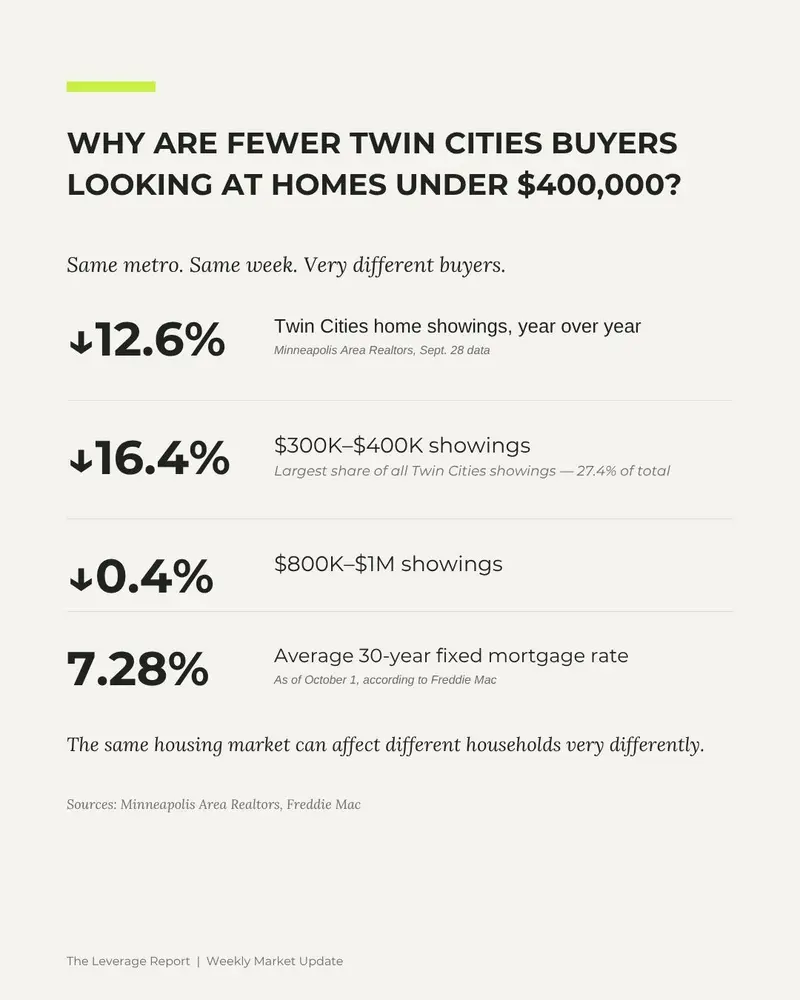
Different parts of the housing market are behaving very differently.
That's why asking “How's the market?” may not tell you nearly as much as it used to.
What is happening in the Twin Cities housing market right now?
Let's start with the big picture.
In August, across the Twin Cities metro:
· New listings increased 8.2% from last year.
· Pending sales increased just 1.1%.
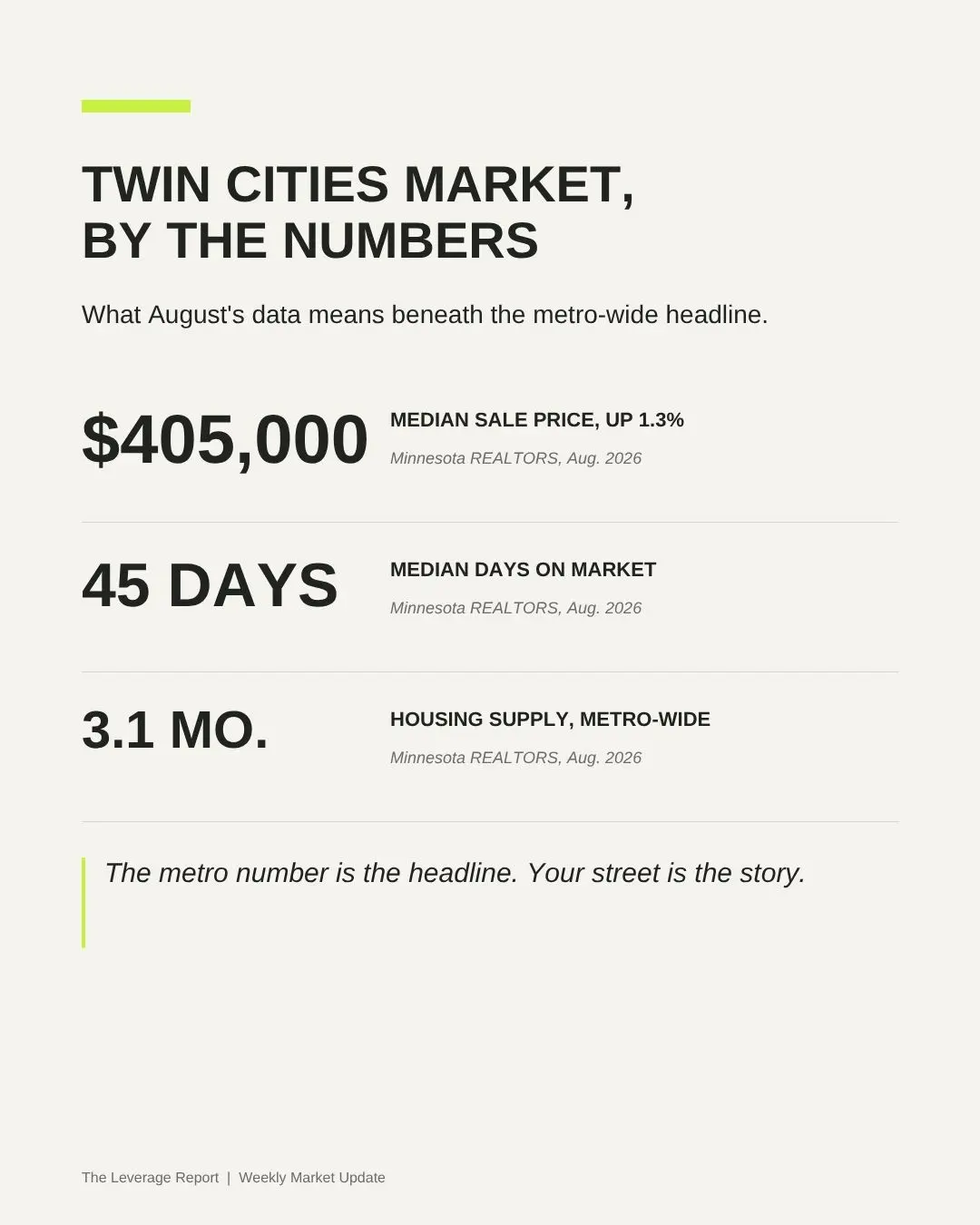
· The median sale price was about $405,000, up roughly 1.3%.
· Homes took about 45 days to sell.
· Sellers received about 98.2% of their original asking price.
· Housing supply reached about 3.1 months.
There's an important detail hiding in those first two numbers.
Homes were coming onto the market considerably faster than additional buyers were putting them under contract.
More recent weekly data showed an even sharper pullback in pending sales, although one week's numbers shouldn't be mistaken for a long-term trend.
In plain English:
Buyers have more choices, while demand isn't growing nearly as quickly as supply.
That sounds like a fairly straightforward market slowdown.
Until we look closer.
Is every part of the housing market slowing down?
No.
This is where the averages start hiding the story.
Looking at statewide Minnesota data for August, different price ranges behaved very differently.
Pending sales of homes priced below $400,000 fell 2.0% from last year.
Meanwhile, closed sales above $1 million increased 15.5%.
Those are different measurements, pending versus closed sales, so they shouldn't be treated as a direct apples-to-apples comparison.
But they help illustrate something important:
Different price segments aren't moving in lockstep.
Property types tell a similar story across Minnesota.
Single-family home sales increased 1.0%.
But:
Condo sales fell 4.3%.
Townhome sales fell 2.5%.
Even the Twin Cities' two largest cities moved differently.
Sales in Minneapolis fell 1.6% from a year earlier.
Sales in St. Paul fell 12.6%.
All of those numbers can be true at the same time.
Because there isn't really one housing market.
What does “the Twin Cities housing market” actually mean?
When we talk about “the housing market,” we're combining thousands of very different properties into one set of averages.
A $275,000 condo in St. Paul.
A $425,000 single-family home in Oakdale.
A $650,000 house in Woodbury.
A million-dollar home in Edina.
Technically, they're all part of the Twin Cities housing market.
But they're not necessarily competing for the same buyer.
They don't have the same amount of inventory.
They don't face the same affordability challenges.
And they don't necessarily have the same negotiating dynamics.
That's why a headline saying “Twin Cities inventory is up” can be completely accurate while still telling you very little about the specific house you're trying to buy or sell.
The metro-wide numbers tell us the market is changing.
The segment-level numbers tell us why the average isn't enough.
Are Twin Cities home prices falling?
Not overall.
Despite more inventory and slower activity in parts of the market, the Twin Cities median sale price was still about 1.3% higher than a year ago in August, at roughly $405,000.
That's an important distinction.
A slower market does not automatically mean a falling market.
Buyers have more choices.
Homes are taking longer to sell.
Sellers are receiving slightly less of their original asking price.
But so far, those changes haven't translated into an overall year-over-year decline in the metro's median sale price.
Is the Twin Cities becoming a buyer's market?
I wouldn't describe the entire Twin Cities that way.
The metro reached about 3.1 months of housing supply in August.
That's considerably more supply than Twin Cities buyers had during the tightest recent markets.
But it remains below the roughly five to six months of supply that Minnesota Realtors describes as a healthy, well-supplied market.
More importantly, that 3.1-month figure is another metro-wide average.
One neighborhood, price range or property type could have buyers competing aggressively.
Another could have sellers reducing prices and negotiating concessions.
Sometimes those homes aren't very far apart.
What does this mean if you're buying a home?
This is where the changing market can create opportunity.
But I wouldn't assume:
“Inventory is up, so I can negotiate aggressively on every house.”
Instead, I'd want to know:
How long has this particular home been listed?
Has the price already changed?
How many similar homes are available?
How quickly are those alternatives selling?
What condition is this house in compared with them?
Is there other buyer interest?
What do recent comparable sales tell us?
Those answers tell you much more about your negotiating position than a metro-wide statistic does.
Your leverage isn't determined by the average Twin Cities home.
It's determined by the competition surrounding the house you're actually considering.
What does this mean if you're selling a home?
The same principle works in reverse.
Your biggest competition isn't necessarily “the Twin Cities housing market.”
It's the handful of homes a potential buyer will compare with yours.
If buyers have three good alternatives in your neighborhood and price range, your positioning matters considerably more.
If there's almost nothing comparable available, the broader slowdown may matter considerably less.
That's why preparation, condition and pricing become especially important as inventory grows.
Not because buyers disappeared.
Because buyers have alternatives.
So, is the Twin Cities housing market good or bad right now?
That's probably the wrong question.
The better question is:
What is the market doing for a home like this one?
Because right now:
Inventory is rising.
Prices are still slightly higher than last year.
Some buyers have more negotiating room.
Some sellers still have significant leverage.
Some price ranges are slowing.
Others are performing much better.
Some property types are weakening.
Others aren't.
None of those statements contradict each other.
They're evidence that the housing market is becoming more segmented.
And that makes understanding the specific property increasingly important.
The bottom line
There isn't one Twin Cities housing market.
There are thousands of smaller markets divided by location, price, property type, condition and buyer demand.
The metro-wide numbers are useful because they tell us which direction the tide is moving.
But they don't tell us exactly what's happening around one particular house.
The market matters.
Your market matters more.
That's the distinction I'll keep watching as we head further into the fall market.
Twin Cities Housing Market FAQ
Is the Twin Cities housing market slowing down in 2026?
Parts of it are. Twin Cities inventory has increased, homes are taking longer to sell, and new listings grew substantially faster than pending sales in August. However, prices remained slightly higher than a year ago, and conditions vary by location, price range and property type.
Are Twin Cities home prices dropping?
Not overall. The Twin Cities median sale price was approximately $405,000 in August 2026, about 1.3% higher than August 2025.
Is the Twin Cities a buyer's market in 2026?
Not uniformly. The metro had about 3.1 months of housing supply in August. Buyers generally have more choices than during the tightest recent markets, but competition and negotiating leverage vary significantly by neighborhood, price point and property type.
Do Twin Cities home buyers have more negotiating power?
Generally, buyers have more opportunities to negotiate than when inventory was extremely limited, but leverage is property-specific. A home's price, condition, time on market, competing inventory and buyer interest all affect how much negotiating room actually exists.
Sources: The metro and statewide August figures come from Minnesota Realtors' August 2026 Housing Market Report, using MLS data including NorthstarMLS. The more recent weekly context comes from Minneapolis Area Realtors' weekly market reporting.