Market Updates
The Best Week to Buy a Twin Cities Home?
Apparently, we're almost there.
According to new research from Realtor.com, September 27 through October 3 could be the best week of the entire year to buy a home in Minneapolis-St. Paul.
And the numbers behind that claim are pretty compelling.
Based on historical seasonal patterns, Realtor.com expects Twin Cities buyers could see:
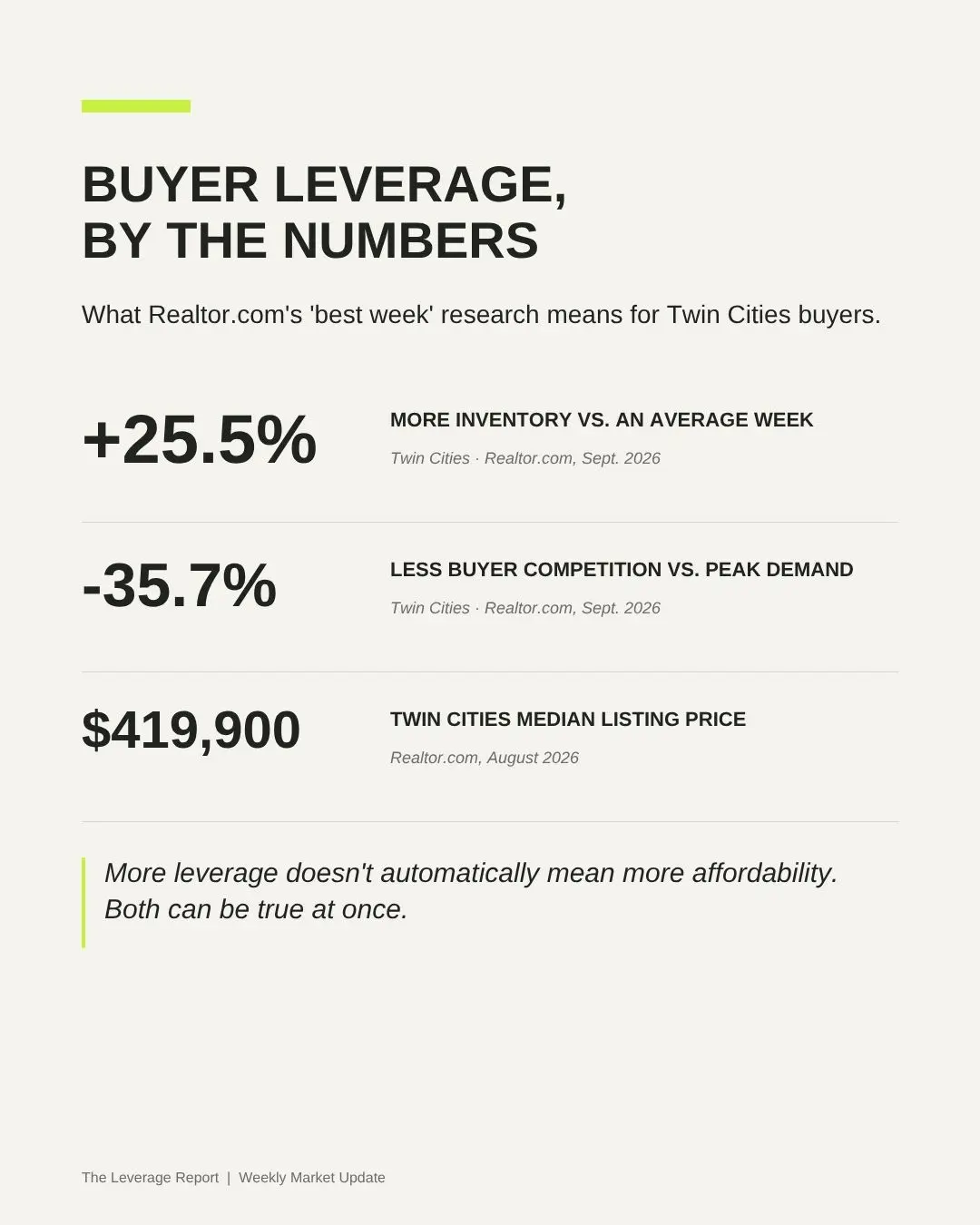
🏠 +25.5% more inventory than during an average week
👥 -35.7% buyer competition compared with peak demand
⏱️ +12 days on market compared with the fastest-moving point of the year
📉 -8.0% median listing prices compared with their seasonal peak
Put all of that together and it sounds like the stars are finally aligning for buyers.
But there's an important piece of fine print:
Mortgage rates aren't included in determining the "best week."
And that changes how I think we should interpret this.
What does "best" actually mean?
It doesn't necessarily mean homes suddenly become cheap.
It doesn't mean mortgage payments will be at their lowest.
And it definitely doesn't mean you should circle September 27 on the calendar and refuse to buy anything until then.
What the research is really identifying is something more useful:
A period when buyers may have more leverage.
More inventory means more choices.
Less competition means fewer buyers fighting over those choices.
Longer market times give buyers more time to make decisions and can create more motivated sellers.
And more price reductions can create opportunities for negotiation.
That's a very different environment from one where you tour a house Friday night and have to decide whether to fight five other buyers for it by Sunday afternoon.
And we're already seeing some of it
This isn't just a historical forecast.
Realtor.com's August 2026 Minneapolis-St. Paul data shows:
- $419,900 median listing price
- +32.9% inventory compared with last year
- 20.3% of listings had a price reduction
That's what caught my attention.
The "best week" is still a projection based on historical seasonal patterns. But some of the conditions that could create more buyer leverage are already showing up in the Twin Cities market.
More inventory.
More price reductions.
More choices.
That doesn't mean every neighborhood or price range suddenly favors buyers. Real estate is intensely local.
But the balance is worth watching.
That 8% number needs an asterisk
This is probably the easiest number to misunderstand.
An 8% decline from peak listing prices does not mean the same house suddenly became 8% cheaper.
Real estate is seasonal.
The mix of homes hitting the market changes throughout the year. So I wouldn't look at that number and conclude:
"Great. I'll just wait until October and save 8%."
Instead, pay attention to what the broader numbers are telling us:
More choices. Less competition. More time. More price reductions.
Those are tangible advantages for a buyer.
And they're exactly the kind of advantages that can create opportunities beyond the asking price.
Price isn't the only thing you can negotiate.
When sellers have three, five or ten offers, the seller usually gets to dictate the terms.
When a home has been sitting for a couple of weeks?
That's a different conversation.
A buyer may have a better opportunity to negotiate:
• Seller-paid closing costs
• Inspection repairs
• Flexible closing dates
• Seller-paid interest-rate buydowns
• Contingencies
• And yes, the purchase price itself
That's why I think leverage is a much better way to understand this research than simply calling it the "best week to buy."
Then there's the mortgage-rate problem.
This is the part I think deserves more attention.
Realtor.com's methodology evaluates housing-market conditions including inventory, buyer demand, market pace, listing prices and price reductions.
Mortgage rates aren't one of the factors used to determine the winning week.
That's important because most financed buyers aren't really shopping for a purchase price.
They're shopping for a monthly payment.
A slightly cheaper house financed at a significantly higher interest rate could cost more each month than a more expensive home financed at a lower rate.
The reverse can also be true.
So there really isn't one magical week when buying a house suddenly becomes a great idea for everyone.
There are simply periods when certain parts of the equation become more favorable.
And several of those pieces appear to be moving in buyers' favor.
What does this mean for sellers?
Don't panic.
This research doesn't mean you missed your chance to sell.
It means the strategy changes.
When buyers have more homes to choose from, sellers have less room for mediocre presentation, aspirational pricing or the classic strategy of putting a sign in the yard and hoping for the best.
Buyers compare.
Homes that are priced correctly, prepared well and positioned clearly against their competition can still stand out.
The ones that aren't may find themselves chasing the market with price reductions.
And when roughly one in five Twin Cities listings had a price reduction in August, that's worth paying attention to.
So should you wait until September 27?
Probably not.
At least, not because somebody declared it the best week of the year.
The better question is whether the market is giving you enough leverage to make a move that works for you.
If you're a buyer:
What homes have been sitting? Where has competition cooled? Which sellers may be willing to negotiate? And what would the monthly payment actually look like?
If you're a seller:
What alternatives are buyers comparing your home against, and how should that affect your price and positioning?
Because the "best week" isn't really about a date on the calendar.
It's about leverage.
And we're already seeing signs that the balance is changing.
THE LEVERAGE REPORT
More inventory. Less competition. More time. More price reductions.
Those conditions don't automatically make buying a home easy.
But they can make being a prepared buyer considerably more powerful.
And that's the part of the "best week to buy" headline worth paying attention to.
Sources: Realtor.com 2026 Best Time to Buy analysis and August 2026 Minneapolis-St. Paul housing-market data.